Part I

I do not necessarily identify as an activist nor consider myself to be very politically engaged. As an artist, this feels contradictory; I have been taught that all art is political. While I do not disagree with this idea, I often struggle to see the connection. I’m taking this class with an open mind and a willingness to learn.
Website: www.nifole.com
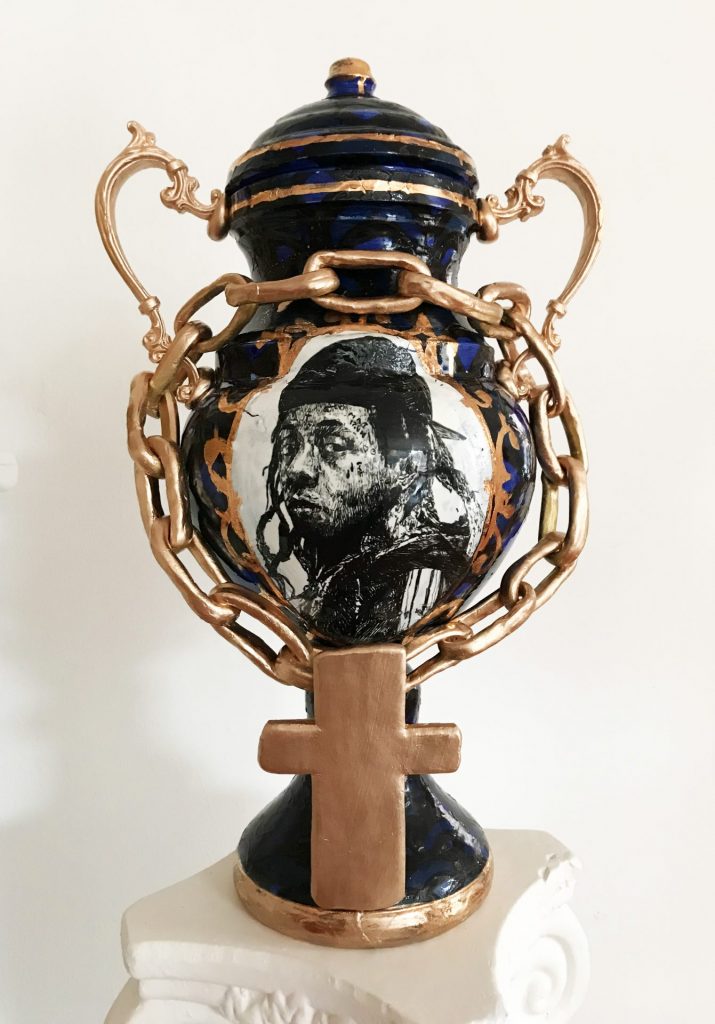 |
| Stunting, 2020 Roberto Lugo |
Ceramicist Roberto Lugo is one of my favorite contemporary artists. I’m drawn to his work for the way it merges a timeless material with modern culture.
Part II
Understanding Patriarchy, bell hooks
1. "Patriarchal thinking shapes the values of our culture. We are socialized into this system, females as well as males. Most of us learned patriarchal attitudes from our families of origin. These attitudes were reinforced in schools and religious institutions," (Hooks, 3).
Hooks argues that patriarchy is learned, normalized, and reinforced through everyday institutions, shaping how people think long before they can question it. This makes dismantling it challenging, since it requires unlearning ingrained values that have been passed down, and continue to be passed down.
2. "Despite the many gains of the contemporary feminist movement-- greater equality for women in the workforce, more tolerance for the relinquishing of rigid gender roles-- patriarchy as a system remains intact, and many people continue to believe that it is needed if humans are to survive as a species," (Hooks 4).
This quote feels unsettling because it acknowledges progress while refusing the idea that progress equals liberation. Hooks emphasizes that even as gender roles loosen, the belief in the patriarchy and the underlying necessity remains. It suggests that equality in surface-level spaces doesn’t magically change the system itself.
What Memes Owe to Art History, Alice Bucknell
1. "In the post-internet world, nothing escapes the meme’s comic gaze, and the form is being recognized as an artistic medium for this interconnected online moment."
This statement captures how memes function as a kind of cultural equalizer. Disregarding seriousness, authority, and even tragedy into something shareable. The gaze of a meme suggests both intimacy and detachment, allowing people to process realities through humor.
2. "Performance brought art into the street and public spaces, leveling the gap between artist and audience. Similarly, memes offer a highly accessible and interactive platform of production that is ripe for challenge and dissent, with disagreements and controversy only fueling the fire of a successful meme truly going viral."
This comparison highlights how both performance and memes disrupt traditional art hierarchies. By existing in public and digital spaces, they invite participation rather than passive viewing, blurring the line between creator and audience. The idea that controversy fuels something to go viral reinforces how expressing an opinion itself becomes part of the circulation of the work.
Memes Are Our Generation's Protest Art, Sage Lazzaro
1. "Under Donald Trump specifically, Burroughs says, memes have grown in popularity as a way to express political opinions, similar to how George W. Bush’s presidency gave rise to liberal blogs. Most are rooted either in expressing anger, mocking Trump, or collectively coping with the absurdity and even trauma of his presidency."
This idea shows that memes are not just political, but emotional too. They help people deal with anger, fear, and confusion by using shared humor during a stressful political time.
2. "Most people interact with these images in fleeting ways as they scroll through their feeds, but creating or consuming political memes that align with one’s point of view can be therapeutic. They reflect what’s happening in society, and help justify feelings of rage and fear while helping us feel less alone."
This shows how political memes work on an emotional level, even when they’re consumed quickly. Despite their short lifespan on a sceen, they can validate people’s feelings and offer comfort by showing that others share the same anger or fear.


No comments:
Post a Comment